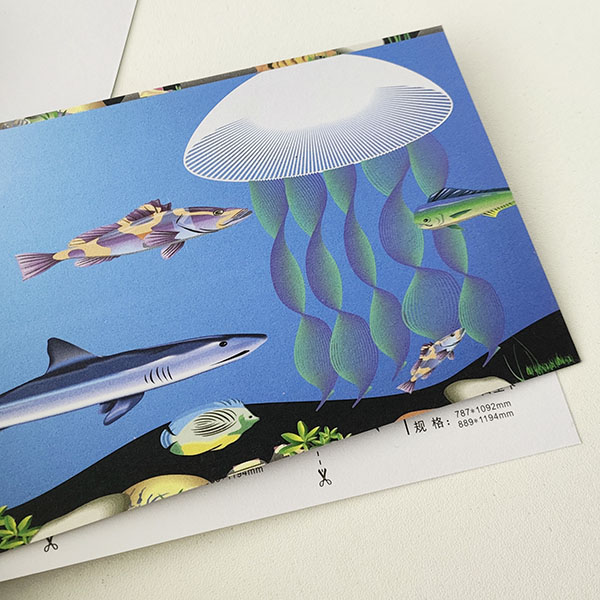
Printing brochures is essential promotional material for many businesses. To further enhance a company's image, many businesses opt for special paper printing when creating brochures. High-quality paper can effectively highlight a company's strength.
However, printing on special paper differs from printing on regular paper. Today, let's delve into the considerations when printing brochures on special paper.
1. Grain Direction:
When using special paper for printing, it's crucial to ensure that the grain direction does not conflict with the binding direction of the brochure. Utilizing the most cost-effective paper cutting method can save costs while achieving excellent results.
Paper with rich surface textures and clear grain patterns may cause ink to not adhere uniformly to the paper surface, leading to slight leakage along the grain lines. Some special papers may have uneven surfaces, making them unsuitable for high dot resolution requirements.
2. Ink:
Special papers with exceptionally smooth surfaces have poor ink absorption, making them prone to smudging during printing. It is advisable to use quick-drying inks and incorporate drying oils in various ink colors to expedite ink drying and prevent surface smudging issues.
For special papers with high surface smoothness like pearlescent paper, ice white paper, or high-gloss coated paper, it's recommended to avoid oversaturation of ink during printing. Excessive ink application on ultra-smooth surfaces can lead to backside smudging issues due to poor ink absorption.
On the other hand, rough-surfaced special papers like handmade paper, double adhesive paper, rice paper, kraft paper, writing paper, or laid paper exhibit visible textures and are more ink-absorbent. Ink tends to penetrate into the paper's texture, resulting in lighter colors upon drying and reduced print quality. Hence, a higher ink application and saturation level are required for such special papers.
3. Test Printing:
When printing on special paper, machine pressure during start-up may cause initial printed sheets to appear darker due to vibrations. This can lead to color instability in the first few sheets. Excessive machine stops during flatbed printing can result in significant wastage. Due to the higher cost of special paper, material allowances provided by staff are minimal during order placement. Additionally, the printing requirements for special papers are more demanding than regular papers. Therefore, it is challenging for the machine operator to ensure consistent quantity and quality prints using standard printing practices.
To address this issue, machine operators must place around 10 sheets of other thickness white paper or single-sided white paper on top of the special paper on the feed table gap. This approach ensures that the initial prints are made on the white paper before transitioning to the special paper, ensuring stable and consistent color output for high-quality printing on special paper.
4. Drying:
Different special papers have varying ink absorption rates. Smooth-surfaced papers are less prone to drying quickly and require longer drying times before inspection to prevent backside smudging.
Printing on special papers is a meticulous process that requires careful attention and control at every stage to ensure a smooth printing production process.